All films contain red herrings, and while The Shining definitely contains them, what I’d call them is more of a duality in messaging. The Semiotic Splice is a part of The Maze Device and focusing on the fatalism aspect specifically: it is a sentence or instance that can be both a false set and a true depending on the factors you’re looking at. Like how purple is both red and blue, the semiotic splice contains elements which are false AND which that is true, depending on the contexts of each element.
Mentally tracing and keeping track of these instances would be impossible as they are not fully formed, but when looked at collectively, each give the viewer a 'choice' as to which 'way" a symbol will be interpreted. A semiotic "choose your own adventure", where you can hear/look at each symbol or instance at face value or give the message a little bit more metaphorical consideration and an entirely new world of meaning is born.
Semiotic Splice + the Domestic Abuse Narrative
“Is There Something Bad Here”
The splice here is the "Is there something bad here" after being set up with the "I guess you could say the Overlook Hotel here has something about it that's like shining".
From No.6, we see that Danny sees past incidents in relation to the hotel, but the "bad thing" is shown No.41. The warning is shown No.6, No.12, No.38.
So the true fatalism is that there IS something bad here, it's Jack and it was brought here.
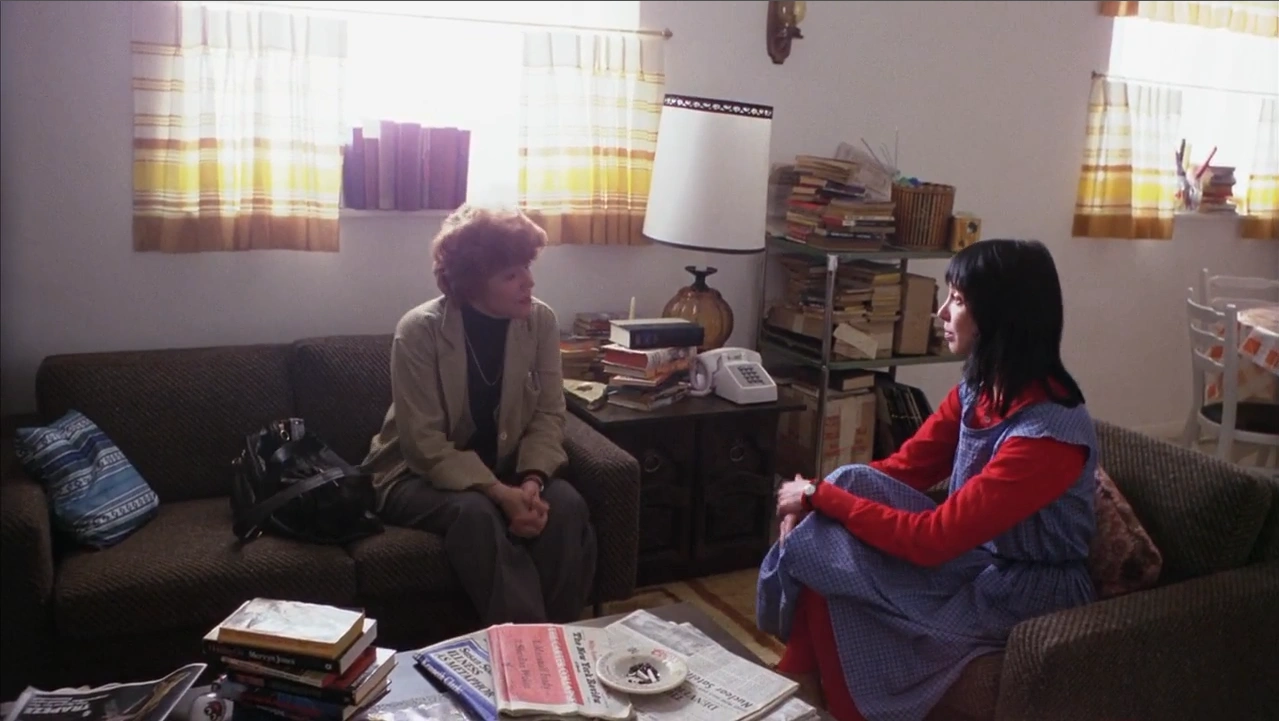
Simultaneously it is false fatalism because the "ghosts" that we see are not here to harm the Torrances but serve other functions: In Danny's case the Grady Girls warn him of the true danger, in Jack's case they serve to protect and serve Jack's ego in regard to his hatred for his family and his desire to be famous and "great", in Wendy's case they shove in her face the truth that she's been avoiding by various distractions/indulgences (books, television, smoking, outright denial)
“Say Like Someone Burns Toast”
In a literal interpretation, this line speaks to sensing something but not experiencing it directly.
It speaks to Kubrick having a scene where Danny and Halloran talked about eating ice cream. We see the ice cream covered bowl and Danny’s face, but we are not shown the ice cream being eaten.
We hear the setup, we see the result, but not the event. This is how Kubrick handles Room 237.
Wendy walking through Jack’s path is a literal example. She literally walks through his path, smelling the smoke to see the fire.
In this example we see the event, and we witness another character get ‘caught up’.
In a metaphorical interpretation, it speaks to the remnants of a situation, lingering behind. The event may have transpired, but a residue remains.
In the Domestic Violence narrative, the burnt toast analogy reflects The Incident and how it haunts the Torrance family, how alcoholism haunts Jack, how Jack’s actions haunt Danny, how Jack’s inadequacy haunts him.
“Mr. Halloran, What Is in Room 237?”
The splice here is Danny showing awareness of a specific room and that it’s something to be scared of. No.19 is the first we hear about Room 237. In No.6, we’re shown a sequence of events in Danny’s mind, but Room 237, its interior, its key, and anything indicating that this specific room scares him are absent.
Danny’s question creates the gap, and Kubrick asks us to fill it. The false fatalism is that because Danny can see information about future and past events, we accept that Room 237 must have been included, that we missed it, or that we should simply assume his knowledge as a fact. We supply a connection we were never shown.
The true fatalism of Danny asking “what’s in Room 237?” is that Danny is aware of specific HARM but can only see the room.
When Danny trikes around Room 237, he walks up to the door and touches the doorknob. Kubrick doubles up on his use of “image as thought,” falsely connecting the Grady Girls of No.6 and No.38, in the West Wing Living Quarters, within the space of Room 237.
As we see in No.48, this space looks nothing like where the Grady Girls are seen in No.38 and No.6, with the separate appearance in No.12.
The important factor of Room 237 is where Danny will be led, invited by a rolled tennis ball to an open door.
The semiotic equivalent to this action is No.41, where Danny is invited to sit on Jack’s lap. This follows Wendy and Danny watching Summer of 42, a film about a young boy losing his virginity inappropriately.
The focal point of Room 237 is not necessarily the room itself, but the inappropriate relationship between Jack and Danny.
So yes, Danny should stay out, but stay away from Jack and his work. Danny cannot. Danny and Jack’s work are inseparable.
Semiotic Splice + American History
The Elevator Blood
A three way connection between American History, Ghost Story, and Domestic Violence; the gushing river of blood is tied directly to Jack’s rage and how that is unleashed on the family.
In the Ghost Story Narrative, the blood symbolizes the amount of death housed within The Overlook and its history. In the Domestic Abuse Narrative, the blood symbolizes the rage of men against those who they’ve promised to love and protect, and in the lager American History Narrative it symbolizes the overarching symbol of culture, power, and will onto others through violent means.
The elevator blood is shown first through a disconnected sequences of images communicated to Danny from his inner protection mechanism, Tony. As the film progresses, the blood is tied directly to Jack’s rage as Danny is shown witnessing/experiencing his parent’s arguing. The final showing has Jack lumbering around the maze to kill his son with Wendy still inside the hotel viewing the actual blood from the elevator. It is here that the messaging is cemented: she, as the viewer, is seeing the reality of the situation; be it supernatural, the state of her marriage, or the country she lives in.
“Can’t Believe It Happened Here, but It Did”
When one takes into the larger view of American History, it’s a landscape of pain, violence, control, and ambivalence to those lost to the group in control.
View No.5.
“Say Like Someone Burns Toast”
“Well, maybe things that happened... leave other kinds of traces behind.”
“Is There Something Bad Here”
In this view, the semiotic splice deals with the truth about America. For some, there are terrifically bad things here. For others, no bad will be seen.
Halloran as Danny’s Spiritual Father
Within the American History narrative, the semiotic splice is that Halloran is more of a father than Jack, and we should look at why that is.
On one level, they share a spiritual connection (Magical Negro trope). However, it can also speak to the history of white families depending on Black people to care for their children while treating those same people as inferior.
Uncle Remus, the Sambo caricature, and the cultural reduction of Uncle Tom belong in this examination of care, service, and racial hierarchy.
Halloran is doing what Jack should be doing: protecting Danny. But protecting Danny means protecting him FROM Jack, and Jack treats that care as interference. The person helping his child becomes his enemy.
Semiotic Splice + Ghost Story
“Is there something bad here”
Most directly this reflects the information we receive in No.5, No.6, No.11 and implied through The Credits. Otherworldly ghost references, tragedies, all create the connection that “the something bad” is very much present, already existing, and ready to repeat its cycle through The Torrance’s.
“Say like someone burns toast / Well, maybe things that happened...
leave other kinds of traces behind.”
A direct reflection of No.5 “Can’t believe it happened here, but it did”. The things we heard about are only a drop in the bucket of the things that have happened within the walls at The Overlook. The scrapbook shown on Jack’s work space reflects this and is part of the novel, but not the film.
Yes, sir. I have a wife and eh two
daughters, sir.
Jack:
And, er... where are they now?
Oh, they're somewhere around. I'm
not quite sure at the moment, sir.”
If Grady's wife and daughters were around the hotel, it's safe to assume that Delbert Grady HAD been the caretaker, that he HAD killed himself and his family, and that the ghosts of these people would still be around the hotel. Neatly tying up the Grady girls Danny sees, the gross woman in 237 could assumed to be Grady's wife, and here's Grady 'taking care' of the new caretaker.
While those facets do line up, when compared to the rest of the context of the film, it's a flimsy adaptation of the semiotics we keep seeing.
No.53 “
I'm sorry to differ with you, sir,
but you are the caretaker. You
have always been the caretaker, I
should know, sir. I've always been
here. “
False fatalism: Grady is no longer the caretaker because he's dead. He's "always been here" meaning he's a ghost trapped in the hotel.
True fatalism: Grady is an aspect of Jack's psyche, asserting to Jack that Grady is of service to HIM and that Jack is completely in control. "I've always been here" means the aspects of Grady/that Grady represents have always been present within Jack and now he's finally 'facing' them.
Jack harming his family because of ghosts or hotel influence
“
Come on, hon, wake up. You just
had a bad dream. Everything's okay.
Tony:
Danny can't wake up, Mrs. Torrance.
Danny, wake up! Come on, right now, “
with No.45
Jack:
I had... I had the most terrible
nightmare I ever had. It's the
most horrible dream I ever had.
It's okay. It's okay, now. Really."
Wendy is desperate to continue the status quo of barely okay as "everything's okay".
False fatalism of how this is effected by ghosts: The woman in 237 scared Danny, and Jack- so sent both in a spiral where they're haunted by “literal” ghosts and not the more conceptual ghosts of their past and their relationship as Father and Son.
Jack reverts to Gold Room and see those ghosts/the hotel who manipulate him into 'doing their bidding', which is harming Danny and Wendy.
Danny reverts back to Tony, who we know from No.7 was introduced because Jack harmed Danny.
Jack has always wanted to (and does) harm Danny and Wendy and provided himself an 'excuse'.
Semiotic Splice + Cabin Fever
Come on, hon, wake up. You just
had a bad dream. Everything's okay.
Tony:
Danny can't wake up, Mrs. Torrance.
Danny, wake up! Come on, right now, “
with No.45
Jack:
I had... I had the most terrible
nightmare I ever had. It's the
most horrible dream I ever had.
It's okay. It's okay, now. Really."
Wendy is desperate to continue the status quo of barely okay as "everything's okay".
False fatalism of how this is effected by ghosts: The woman in 237 scared Danny, and Jack- so sent both in a spiral where they're haunted by “literal” ghosts and not the more conceptual ghosts of their past and their relationship as Father and Son.
Jack reverts to Gold Room and see those ghosts/the hotel who manipulate him into 'doing their bidding', which is harming Danny and Wendy.
Danny reverts back to Tony, who we know from No.7 was introduced because Jack harmed Danny.
Jack has always wanted to (and does) harm Danny and Wendy and provided himself an 'excuse'.