a state of affairs or an event that seems deliberately contrary to what one expects
In No.50, Jack delivers “It is so typical of you to create a problem like this, when I am really into my work”, and it is laden with irony.
Wendy has created zero problems, Danny has created zero problems, and Jack’s lack of concern for his family goes unnoticed.
The work, however, is the irony:
Jack continually isolates himself from his family in order to get work done. During No.24 conversation, he tells Wendy he's got tons of ideas but no good ones. No.25, he's shown distracted/assumed writer's block, but by No.31, he's actively writing and acerbic and cruel when Wendy approaches him to feed him. No.33 shows Jack in the CO lounge but not working. It is assumed he's staring off AT Wendy & Danny playing in the snow, but in reality, the scene shows Jack disconnected from physical, lost in thought or "a self induced trance" (No.7). The irony is he disconnects himself from his family (and self) to dive into work, and it's meaningless.
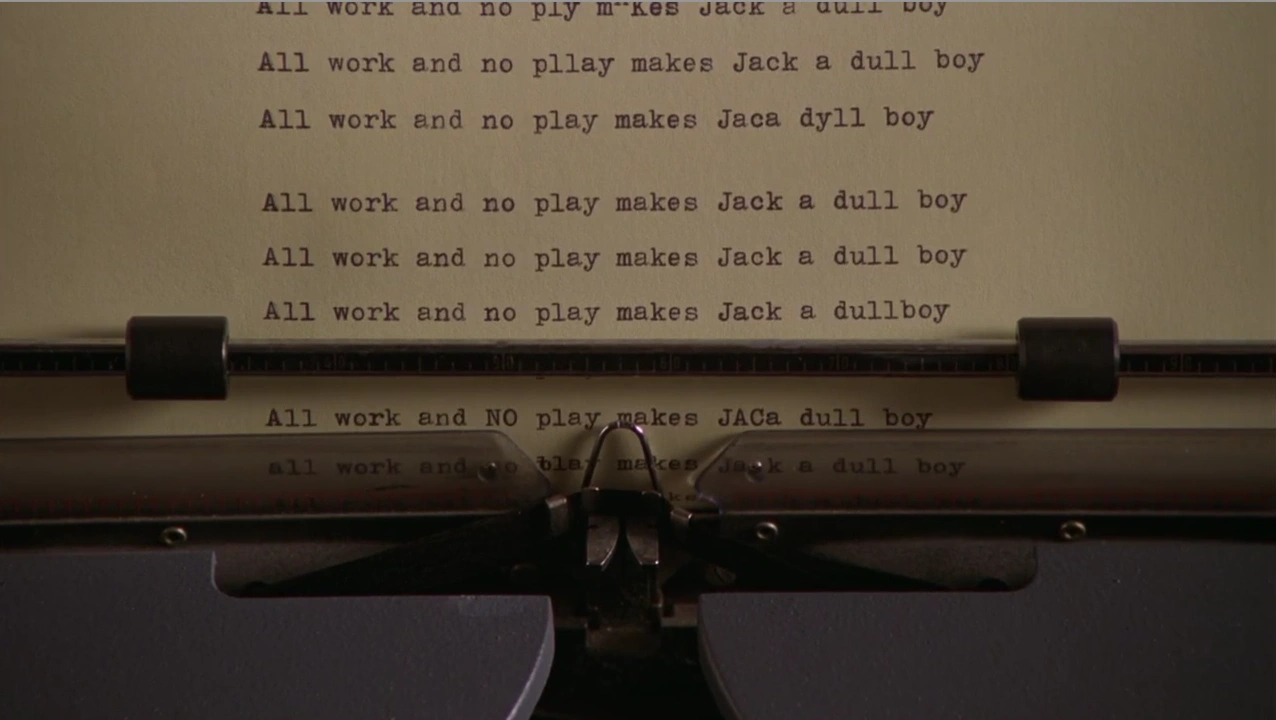
In this image · No.63
Five Months of Peace
No.5’s promise of five months of peace returns as an irony in the manuscript. Jack chose the isolation for his writing, yet resents both his work and the situation he chose. The repeated line can be read as frustration with the labor and loneliness of writing, and as a threat that his turn to “play” is approaching.
Fatalistic Irony and Jack’s Choice
Jack’s decision to give priority to his work is his own, connecting the scene with “I think he did it to himself.” In No.5, he asks for five months of peace for a writing project; in No.24, he says he ought to write; in No.31, he insists he is trying to finish his work. No.33 shows him at the workstation, while No.36 and No.59 show him typing. In No.41, he says he has too much work to sleep; No.45 finds him asleep at the desk. The fatalistic irony rests on a course he repeatedly chooses.