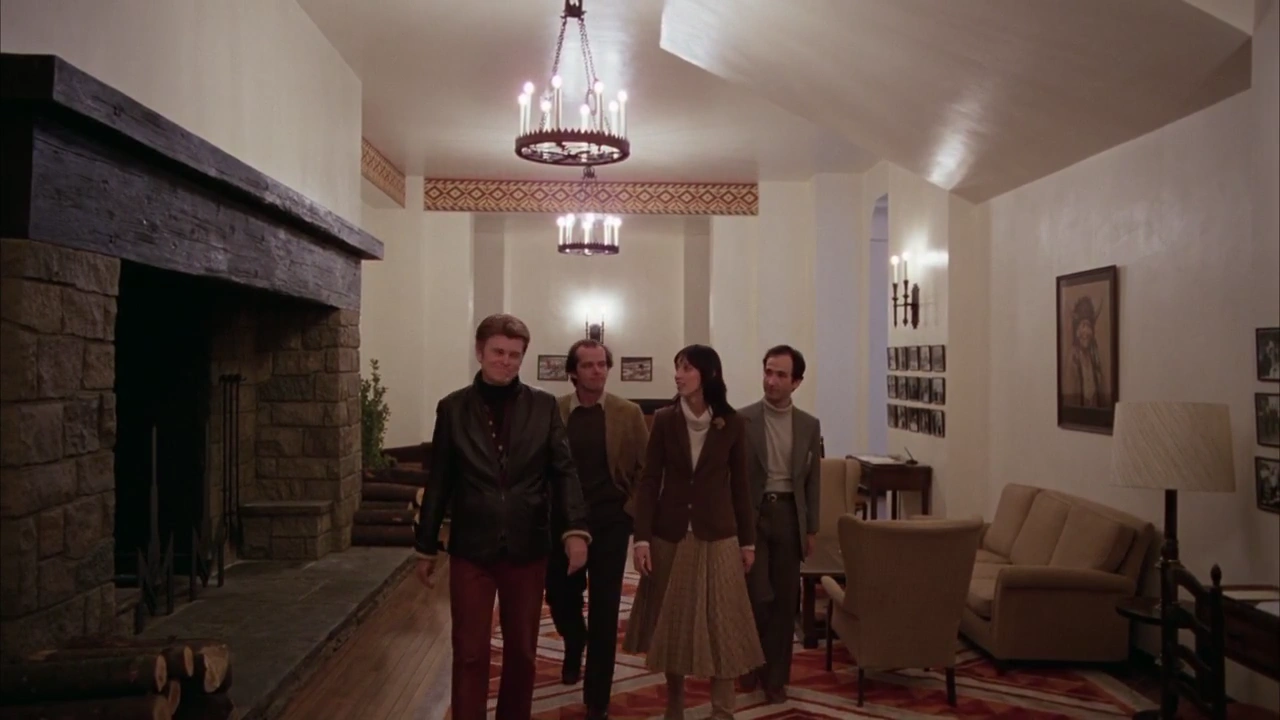
Ullman delivers “all the best people” in No.11, standing in front of a portrait of a Native American chief. That is the joke. Calling royalty, American Presidents, and the wealthy “jet set” the best people is the capitalist PR take: wealth and power are being presented as evidence of goodness. The portrait makes that claim a pointed example of Cultural Relativism.
Celebrating powerful people while obscuring the harm they caused is also how Confederate monuments work. Leopold II, Andrew Jackson, and Woodrow Wilson make the distinction between power and goodness difficult to ignore. This is the connection to American History, Imperialism, Manifest Destiny, and White Privilege.
The next scene, No.12, puts Danny opposite the Grady Girls in the Games Room. They represent the other side of that hierarchy: children at the mercy of those in charge.
Jack’s pursuit of a place among these “best people” connects the promise to the violence we witness. He attacks Wendy, pursues Danny, and kills Halloran. Grady’s demands in No.53 and No.69 make belonging conditional on what Jack will do to his family. The photograph in No.91 places him among the people whose approval he has sought.
In this image · No.11
Ullman: “All the best people.”
Ullman delivers the line seriously, but Kubrick uses it sarcastically, because of course anyone educated knows that being rich, royal, or high up in government does not automatically connote “the best people.”
This sentence reflects compositionally within the scene through the Native American chief and the Black and White Photos.
The sentence thematically connects to No.53 and No.91: how Jack has acted in order to achieve his “place.”