As clearly as Kubrick implies Native American wailing in his credits, Kubrick displays the group in power as a constant presence across the hotel.
Concentrated mostly within The Lobby, The Colorado Lounge, The Gold Room hallways, and The Games Room, the Black and White Photos represent the multitudes of guests that have stayed within The Overlook, those that had a hand in its creation, and in the larger conceptual setting: those who settled the land from the indigenous communities like it was their right.
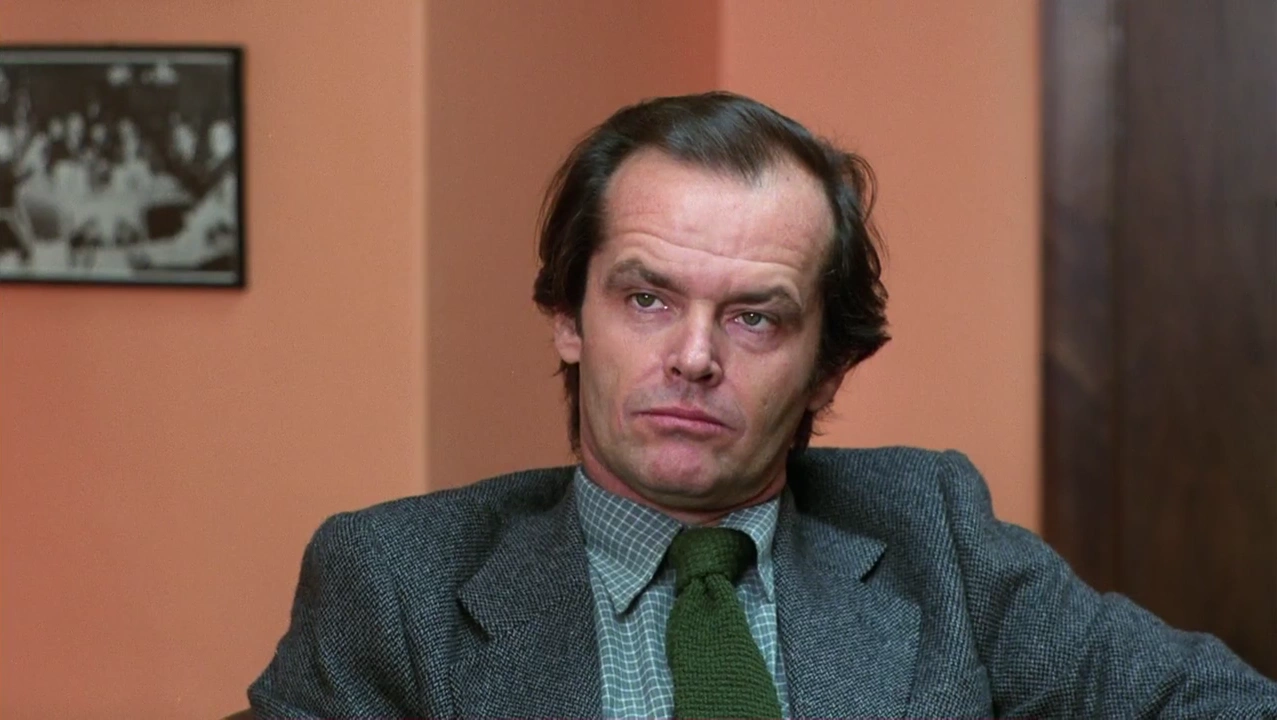
Primarily connected with Jack, we see the association from the very beginning No.5 as he’s interviewing for the job. Those who’ve come before are there from the very beginning (No.53)
B+W Photos and American History
Aside from the literal connection to the past, there are moments that cement what the Black and White Photos symbolize within the American History narrative:
“Oh this old place has had an illustrious past” as the camera pans across a stair-stepped composition of Black and White Photos. This juxtaposition ties the black and white photos to this illustrious past Ullman refers, and this is all a set up for the conceptual punchline. The camera pans across the wall as Ullman is heard speaking off screen, meeting the characters in a space flanked by a oversized fireplace on the left and a significant portrait of a Native American chief on the right (which is itself flanked by a block of Black and White Photos).
This scene accompanies this dialogue:
We've had four presidents
who stayed here, lots of movie stars.
Royalty?
Anyone with a modicum of awareness to history, the major players in powers are rarely “the best people”, which is exactly the joke. Take for example the Belgian King Leopold II or Andrew Jackson, even Woodrow Wilson, zero of them would be even close to the proximity of “best person”. (Note the source novel because it lists the presidents to inspire Kubrick’s tongue-in-cheek joke. Kubrick omitted naming names because American politics is so contemptuous, the joke works regardless of party.
See: Imperialism, Colonialism, Why is Grady British?, Kubrick’s Aesthetic
B+W Photos and Domestic Abuse
B+W Photos and The Maze
Tied within the American History Narrative, the Ghost Story Narrative and The Cabin Fever Narrative, the Maze aspect relies on No.51, No.53 and the inclusion of party goers within The Gold Room. Having the partiers be in solely black, white, and champagne colors literally cements them as “The Black and White Photo” people before No.91’s final scene where we see Jack within the photo itself. On one level, it could be viewed that the ghosts from The Overlook have all ‘risen’ to live one more time amongst their original revelry and Jack is swept up in it. On another level it could be viewed that Jack has conjured up the ghosts as a figment of his imagine that he belongs amongst “The Best People” and the actions that transpire from this point are all done to gain favor.
Regardless of the inclusion of literal people, The Black and White photos act as a guide for Jack and his violence. Starting from No.51, continuing across No.53 and notably as he stalks Halloran to murder him in No.77, mimicking No.11’s “illustrious past” comment.
B+W Photos and The Ghost Story
On the most direct level, the Black and White photos serve as a persistent reminder of presence within this hotel. Seeing balloons and streamers in No.51, the mind already provides “Ghost Party”. No.53 and Jack’s conversation with Grady, a man we’ve known that’s been dead since No.5 is a literal “This is a Ghost Story” moment, but it is Jack’s face we see in No.91, never Grady.
The conversation Grady has with Jack in No.69 has a different dynamic. The “others”, the party goers, the individuals referenced within the black and white photos, act as a peer pressure for Jack to “do their bidding”. Whether this is Jack’s internal pressure and will personified or the ghosts asserting their dominance is a perpetual question left for the viewer.
The viewer getting to witness both No.53 through Jack’s point of view, as well as Wendy’s experience in No.85 presents us with a choice: are we seeing the past clearly? And which past are we choosing to see?
See: Different paths for different people
B+W Photos and Cabin Fever
Seeing the Black and White photos as a connection to the Cabin Fever Narrative serves as an intellectualized rationalization for The Ghost Story narrative. Jack conjures up the black and white photos in a series of hallucinations because of his misery and forced seclusion.
A consistent visual presence— the black and white photos are shown in massive blocks across The Lobby, Colorado Lounge, The Lobby Hallway, The Gold Room-esque Hallway, and The Games Room.
They speak to those we hear about in No.11: the jetset, “All the best people”.
By the time we meet the guests in No.53, we’re not going to question why they’re all in black, white, and champagne.
An interesting fact— these framed photos are taken from the Warner Bros studios and are actual photos of events and people that worked at Warner Bros.
In this image · No.5
Connection to the Black and White Photos
Jack is aligned with the black and white photo.
The Maze
Jack and the black and white photos.
A representation of history, wealth, the looming presence of those who came before, and foreshadowing the final scene.