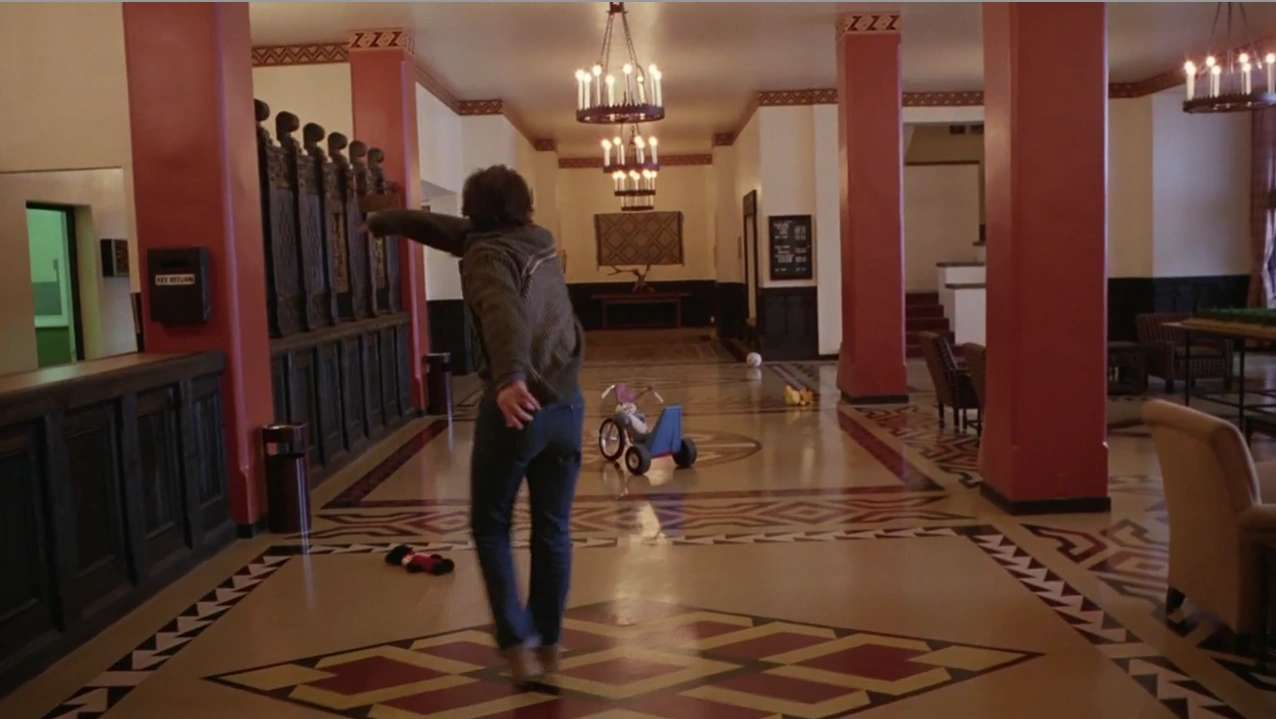
The doll identified in No.26 belongs to a history of anti-Black caricature. Florence Kate Upton’s character became a widely reproduced toy; its minstrel-derived features are part of the racial imagery documented by the Jim Crow Museum.
Its inclusion speaks to racism carried into ordinary childhood objects and supposedly modern culture. In this reading, it represents Halloran among the toys and foreshadows the racist reduction of his role in Grady’s conversation with Jack.
In this image · No.26
The Golliwog Doll
The Gollywog doll on the far left- is a racist doll- a caricature of a caricature - in that the doll is a caricature of a minstrel performer- who was in fact a caricature of a black person.
https://jimcrowmuseum.ferris.edu/golliwog/
Represents Halloran and his jovial, stereotypical ‘jivey’ way he talked, the racist nature in which he is treated in this film - to show the racial problems of America.
Uncle Remus
Uncle Remus is a collection of animal stories, songs, and oral folklore, collected from southern African Americans. Many of the stories are didactic, much like those of Aesop's Fables and Jean de La Fontaine's stories. Uncle Remus is a kindly old freedman who serves as a storytelling device, passing on the folktales to children gathered around him.
The stories are written in an eye dialect devised by Harris to represent a Deep South Gullah dialect. The genre of stories is the trickster tale. At the time of Harris's publication, his work was praised for its ability to capture plantation Negro dialect.
A16: the performing manner in which he shows Wendy + Danny the kitchen
A19: the story about his grandmother, his mannerisms and speech patterns
A38—D “Remember what Mr. Halloran said ‘ Just like pictures in a book, it isn’t real”
the conjunction of the golliwog doll, and Danny’s representation as a rabbit
(as ‘Doc’, and in A26:Image 535 bugs bunny) push Uncle Remus symbolism, but I don’t think it’s as strong as Uncle Tom.