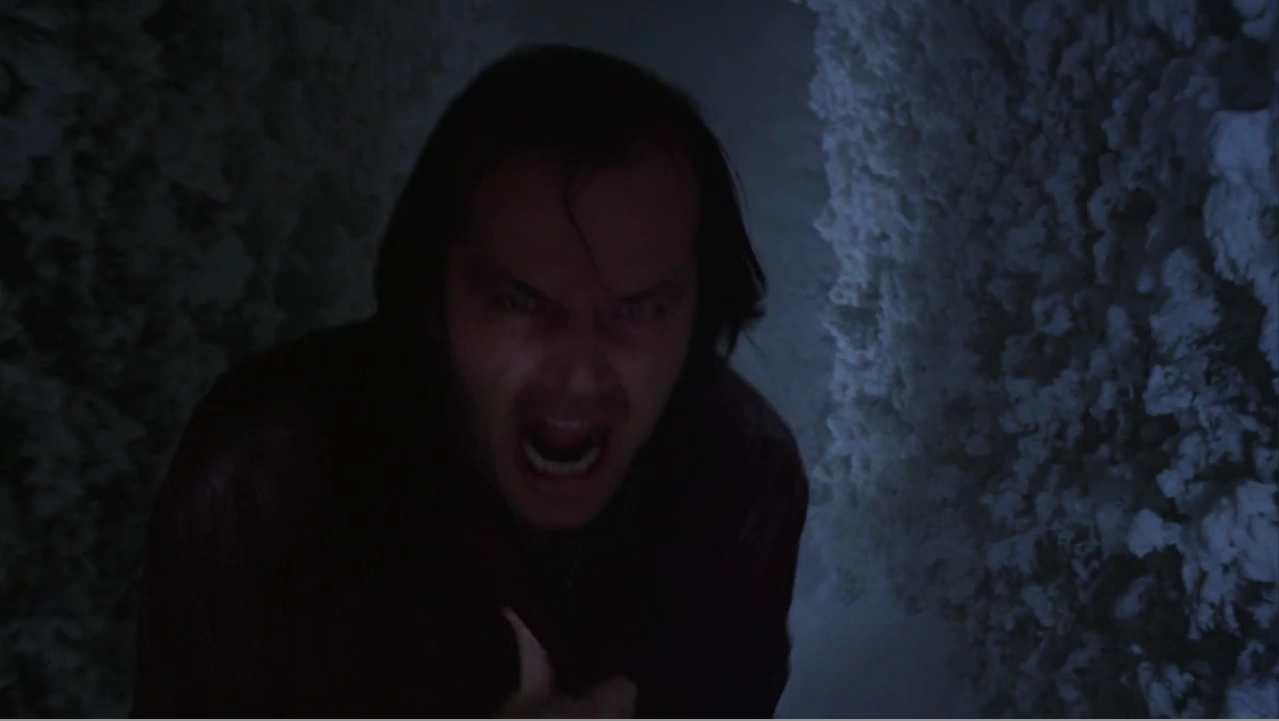
Brain vs. Brawn centers on Danny and Jack’s interactions. Danny survives by thinking through the evidence of his movement, while Jack’s pursuit is governed by rage and force. Jack carries an axe, yet remains fixated on killing his son rather than using the tool to find another way out of the hedge maze.
In No.86, Danny steps backward into his own footprints, then leaves the trail. Jack follows the tracks as though they tell the whole story. Danny understands that the evidence can be made to tell a false one.
This deliberate reversal echoes the film’s documented journeys in opposite directions: Danny’s return through the Green Hallway, Wendy’s revisiting of her earlier Lobby route, and Halloran’s following of Wendy’s path. Repeated spaces become different experiences when direction, purpose, and awareness change.
Within Brain vs. Brawn, reversal becomes a survival strategy. It also connects to The Maze, Kubrick as Unreliable Narrator, and Fatalism / False Fatalism: Danny changes an apparently inevitable outcome by changing how his movements can be read. Is reversal Kubrick’s visual language for the possibility of changing an outcome?
Danny’s footprint maneuver invites investigation into Indigenous tracking and survival traditions. Read alongside the Overlook’s appropriation of Indigenous imagery, the possibility introduces a further contrast: Danny survives through knowledge, while Jack pursues him through violence.
The historical attribution remains unverified. Retracing footprints is a tracking deception, but the evidence gathered so far does not establish a connection to a specific Indigenous nation or show that Kubrick intended one. This remains an interpretive possibility within Brain vs. Brawn. The Lakota Heyóka tradition is a separate subject and is not evidence for the footprint technique.
In this image · No.84
Intelligence Defeats Force
Danny later answers Jack’s intimidation with a practical deception. In No.86 he retraces his footprints, steps away from the trail, and brushes out the connecting marks. Jack loses him in No.88. Danny escapes by reading and changing the evidence his father follows, while Jack continues the same threatening pursuit. The child’s thinking defeats the adult’s force.
A Tool Reduced to a Weapon
Jack carries an axe, yet his attention remains fixed on killing Danny. I read the tool as an unused possibility for making a way out of the maze: Jack can imagine it as a weapon but does not turn it toward his own escape. The contrast exposes the narrowness of his rage and connects the pursuit with the project’s theme of brawn versus brains.